Dynamics 365 and HubSpot solve overlapping problems from very different starting points. HubSpot grew up as an inbound marketing platform and added sales and service on top; Dynamics 365 grew up as an enterprise business application suite and its CRM modules share a data platform with Microsoft’s ERP, Power Platform, and Copilot ecosystem. Both are genuinely good CRMs. Which one fits depends more on what else your business runs on than on any single feature comparison.
The 30-Second Verdict
Choose HubSpot if marketing and sales need to work as one motion, your team is small enough that ease of use matters more than deep customization, and you’re not otherwise committed to the Microsoft ecosystem.
Choose Dynamics 365 if your business already runs on Microsoft 365 and Teams, you need the CRM to eventually connect to an ERP like Business Central, your sales process is complex enough to need real customization, or Copilot and Power Platform automation matter to your roadmap.
Pricing: What Each Platform Actually Costs
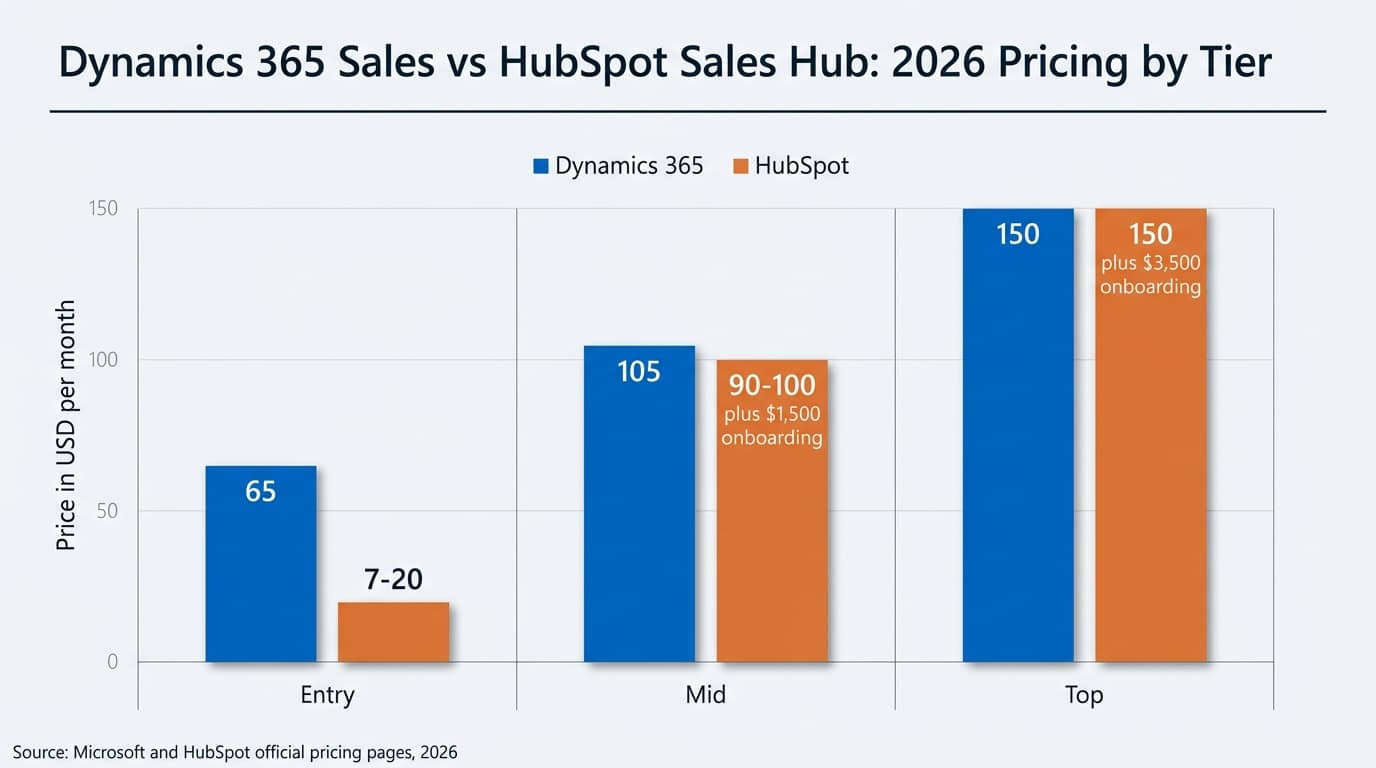
Both vendors publish list pricing, and both change it periodically, so treat these as a snapshot rather than a permanent figure. As of 2026, per Microsoft’s official Dynamics 365 Sales pricing page and HubSpot’s official Sales Hub pricing page:
| Tier | Dynamics 365 Sales | HubSpot Sales Hub |
|---|---|---|
| Entry | Professional, $65/user/month | Starter, $7 to $20/seat/month |
| Mid | Enterprise, $105/user/month | Professional, $90 to $100/seat/month, plus a $1,500 one-time onboarding fee |
| Top | Premium, $150/user/month | Enterprise, $150/seat/month, plus a $3,500 one-time onboarding fee |
The headline comparison that matters isn’t Entry versus Entry: HubSpot’s Starter tier is a genuinely different, much lighter product than Dynamics 365 Sales Professional, not a like-for-like alternative. The realistic comparison for most growing businesses is HubSpot Professional against Dynamics 365 Sales Professional or Enterprise, at which point the two platforms land in a similar price range once HubSpot’s mandatory onboarding fee is factored in.
Where HubSpot Wins
HubSpot’s biggest genuine advantage is that marketing, sales, and service data live in one product with one contact record from day one. For a business whose growth is led by inbound marketing, content, and a tight marketing-to-sales handoff, that unified data model removes integration work Dynamics 365 would otherwise need a separate marketing tool to replicate.
It’s also simply easier to get a small team productive quickly. HubSpot’s interface has a shallower learning curve than Dynamics 365’s, and its free tier gives a very small team a real, if limited, starting point at no cost.
Where Dynamics 365 Wins
Dynamics 365’s advantage compounds the more of the Microsoft ecosystem a business already runs on. Native integration with Outlook, Teams, and SharePoint means CRM data shows up inside tools people already use daily, rather than requiring a separate app; our SharePoint and Dynamics 365 integration guide covers one common example of this.
The deeper advantage shows up for businesses that will eventually need the CRM to connect to financial or operational systems. A Dynamics 365 CRM sits on the same underlying platform as Business Central ERP, so order-to-cash visibility, quote-to-invoice flows, and finance integration are native extensions rather than a custom-built bridge between two unrelated vendors. Our Business Central integration architecture guide covers what that connection actually looks like.
Dynamics 365 also generally offers deeper customization for genuinely complex sales processes, multi-entity data models, custom business logic, and industry-specific workflows, at the cost of needing more implementation expertise to configure well.

Data Residency and Spanish Compliance
Both platforms offer EU data hosting options and both can be configured to meet GDPR requirements; neither has an inherent compliance advantage over the other on that front. Where the practical difference shows up for Spanish businesses is downstream: if your finance or invoicing systems already run on Microsoft (Business Central for VeriFactu and SII compliance, for example), keeping CRM on the same platform reduces the number of integration points that could break or drift out of sync as Spanish e-invoicing requirements evolve. Our VeriFactu compliance guide covers that requirement in more detail.
Switching from HubSpot to Dynamics 365
Businesses that outgrow HubSpot for CRM purposes, while sometimes keeping it for marketing, usually do so for one of two reasons: the sales process has become too complex for HubSpot’s data model, or the business now needs CRM data to connect to finance and operations systems HubSpot doesn’t natively reach. A migration mainly involves mapping contacts, companies, and deal stages across to Dynamics 365’s account, contact, and opportunity model; the same category of work covered from the Salesforce side in our Salesforce to Dynamics 365 migration guide.
Frequently Asked Questions
Is HubSpot cheaper than Dynamics 365?
At the very entry level, yes, HubSpot’s free and Starter tiers cost less than any Dynamics 365 Sales plan. Once you compare the tiers most growing businesses actually need, HubSpot Professional or Enterprise against Dynamics 365 Sales Professional or Enterprise, the price gap narrows considerably once HubSpot’s one-time onboarding fees are included.
Can HubSpot and Dynamics 365 be used together?
Yes, some businesses keep HubSpot for marketing while using Dynamics 365 as the system of record for sales and finance, connected through Power Automate or a dedicated integration. It adds complexity, so it’s usually a deliberate choice rather than a starting point.
Which platform is better for a small business just starting with CRM?
For a very small team with a simple sales process and no existing Microsoft commitment, HubSpot’s free or Starter tier is a genuinely reasonable starting point. Once the business needs deeper customization, ERP integration, or already runs on Microsoft 365, that advantage narrows quickly.
Does Dynamics 365 have marketing tools like HubSpot?
Dynamics 365 Customer Insights – Journeys covers marketing automation, campaign management, and customer segmentation, but it’s a separate licensed module rather than something bundled into the CRM by default the way HubSpot bundles marketing and sales together.
Getting Started
If your business is already on Microsoft 365 or has ERP integration on the roadmap, AlishBit delivers Dynamics 365 Sales implementations for businesses across Spain and Europe, including migrations from HubSpot and other CRM platforms.
Weighing Dynamics 365 Against HubSpot?
Book a free consultation and get an honest read on which platform actually fits your business.