For most Spanish SMEs, a Dynamics 365 CRM implementation costs between €8,000 and €50,000 in one-off services, plus licensing from roughly €60 to €140 per user per month as of 2026. Small, focused rollouts sit at the bottom of that range. Projects with integrations, data migration, and custom development sit at the top.
Those are wide ranges, and the final implementation cost comes down to decisions you control. This guide breaks down licensing tiers, realistic service fees by project size, the factors that push budgets up or down, and the hidden costs that catch Spanish businesses out. All prices are approximate, exclude VAT, and reflect Microsoft’s published pricing as of 2026.
What Does Dynamics 365 Licensing Cost in 2026?
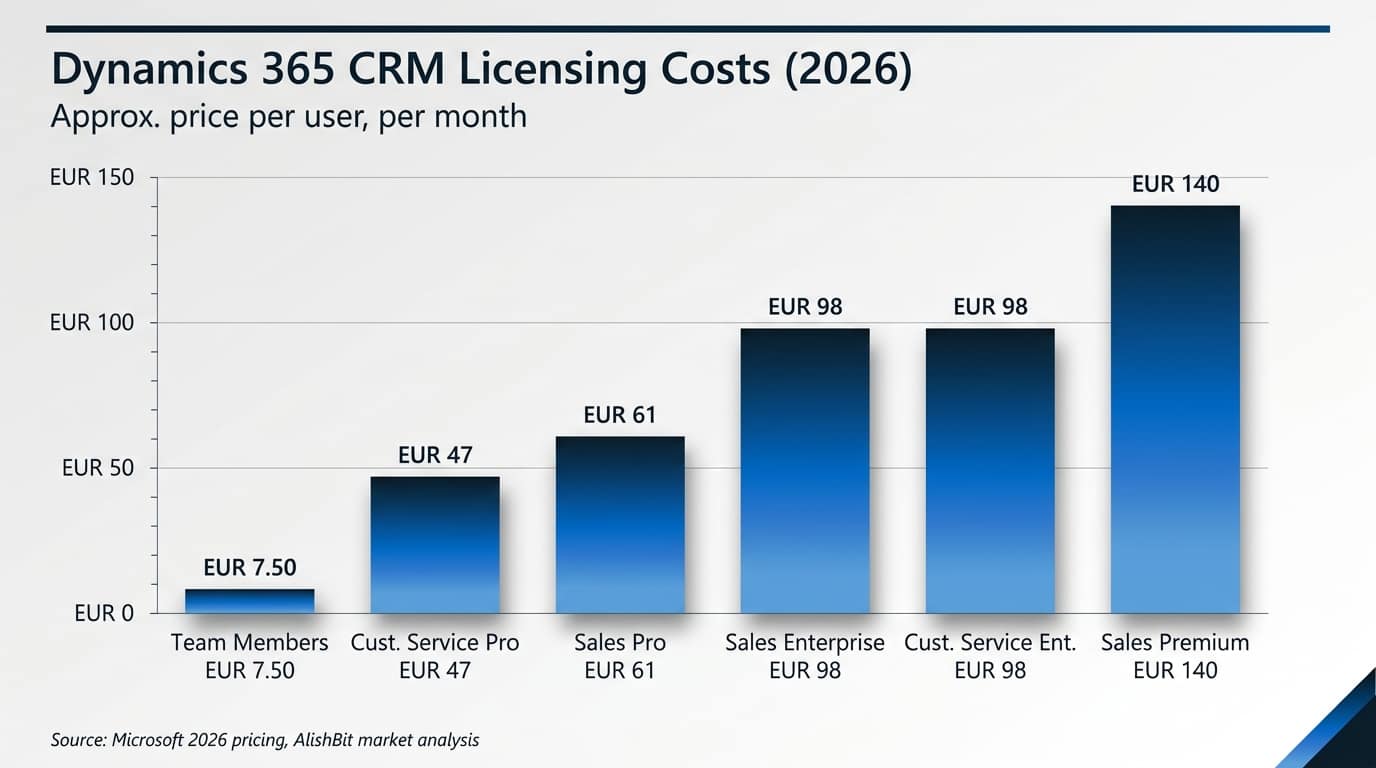
Licensing is charged per user, per month, usually on an annual commitment. You can buy directly from Microsoft or through a Cloud Solution Provider (CSP) partner, which is the common route for SMEs in Spain because the partner bundles support with the subscription. The main CRM licences look like this:
| Licence | Approx. price per user/month (2026) | Best for |
|---|---|---|
| Sales Professional | ~€61 | Core sales: accounts, contacts, opportunities, quotes |
| Sales Enterprise | ~€98 | Forecasting, deeper customisation, embedded intelligence |
| Sales Premium | ~€140 | Sales Enterprise plus advanced AI-driven sales insights |
| Customer Service Professional | ~€47 | Case management for small support teams |
| Customer Service Enterprise | ~€98 | SLAs, entitlements, omnichannel-ready service desks |
| Team Members | ~€7.50 | Light users who view records and add notes |
Two details matter here. First, Microsoft offers discounted “attach” pricing: when a user already holds a qualifying base licence, a second Dynamics 365 app for that same user costs significantly less. Second, euro prices move with exchange rates and Microsoft’s periodic price updates, so always confirm current figures on the official Dynamics 365 pricing page before budgeting. Spanish businesses also add 21% IVA, which is generally deductible.
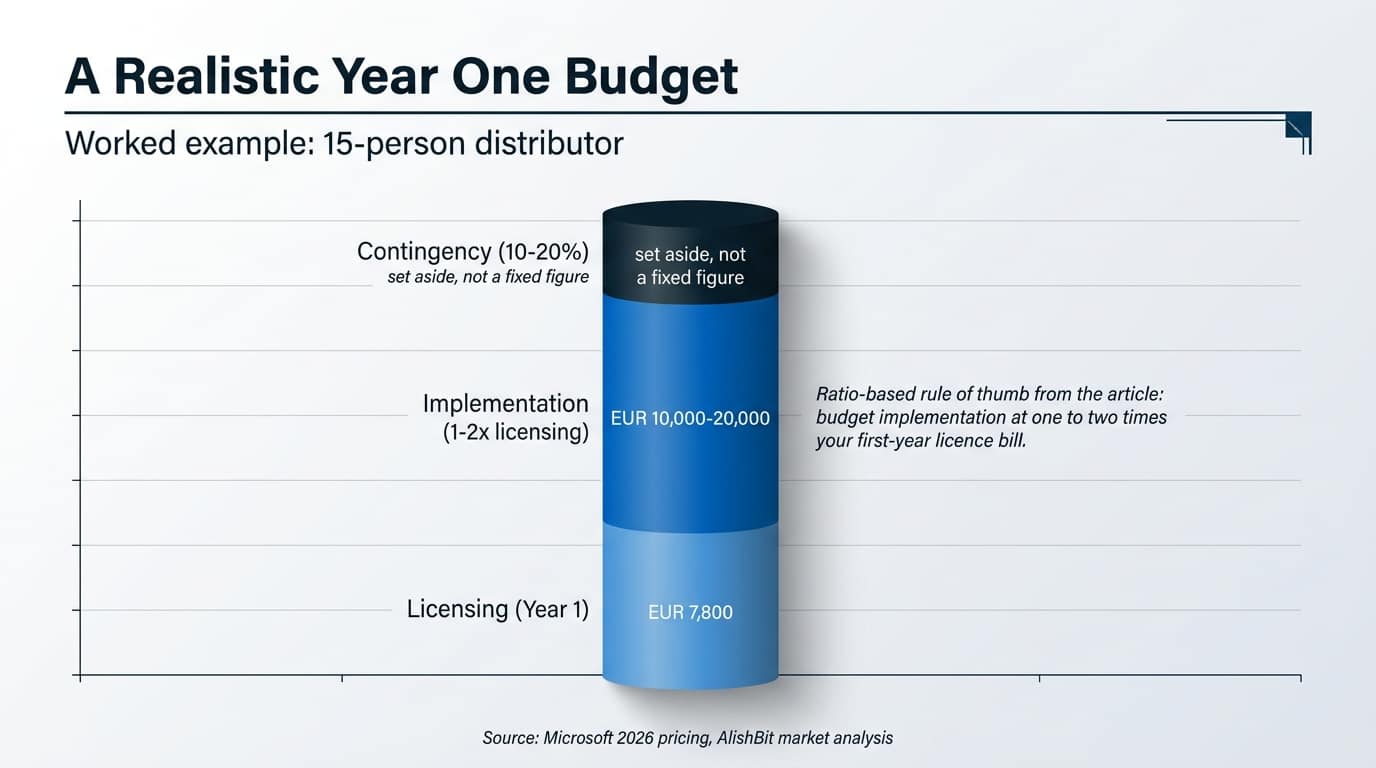
A quick example: a 15-person Málaga distributor with 10 salespeople on Sales Professional and 5 warehouse staff on Team Members pays roughly €650 per month, or about €7,800 per year, before any implementation work.
How Much Do Implementation Services Cost?
The implementation cost is where budgets really diverge. Licences are a known quantity; services depend on scope. Based on typical Spanish market rates, here’s what our Dynamics 365 CRM implementation services tend to cost by project size:
| Project size | Typical scope | Service cost (approx.) | Timeline |
|---|---|---|---|
| Starter (5-15 users) | Standard Sales app, basic configuration, Excel import, two training sessions | €6,000-€15,000 | 2-6 weeks |
| Mid-size (15-50 users) | Custom fields and processes, migration from a legacy CRM, Outlook and Teams rollout, a Power BI dashboard | €15,000-€45,000 | 1-3 months |
| Complex (50+ users or multi-entity) | ERP and web integrations, custom plugins, multiple business units, change management | €45,000-€120,000+ | 3-9 months |
Consultancy day rates in Spain typically run €400 to €900 depending on seniority and specialisation. That’s noticeably below UK or German rates for equivalent Dynamics 365 expertise, which is one reason a growing number of European firms work with Spanish partners on implementation projects.

What Drives the Implementation Cost Up or Down?
The single biggest implementation cost driver is how far you move away from the standard product. Every custom table, plugin, and integration adds build time, testing time, and future maintenance. The main factors that push budgets up:
- Integrations with ERP systems, e-commerce platforms, or industry tools, especially where no standard connector exists
- Messy source data that needs heavy cleanup and deduplication before migration
- Custom development such as plugins, custom pages, or complex approval logic
- Multiple business units with different processes, languages, or security requirements
- Scope creep, the quiet killer: “while we’re at it, could it also…”
And the factors that bring the implementation cost down: staying close to out-of-the-box functionality, rolling out in phases rather than all at once, nominating an internal champion who handles day-to-day questions, and configuring rather than coding wherever possible. Our guide on customising Dynamics 365 CRM for your business needs explains where configuration ends and costly development begins.
Which Hidden Costs Catch Businesses Out?
Quotes usually cover configuration and go-live. The items below are the ones that surprise finance directors six months later.
Data migration
Moving contacts and deals from Excel or a legacy CRM routinely absorbs 10-25% of the total implementation cost. The import itself is quick; cleaning duplicates, fixing inconsistent company names, and mapping old fields to new ones is what takes time. If your data lives in five different spreadsheets, say so during scoping, not after.
Training and adoption
Budget for role-based training sessions, not a single generic demo. A CRM nobody uses is the most expensive kind, because you keep paying licences while your team keeps working in Excel. Plan refresher sessions a month after go-live, when real questions have surfaced.
Integrations and middleware
Standard connectors for Outlook, Teams, and SharePoint are included. Connecting to an ERP, a web shop, or a niche Spanish invoicing tool often means Power Automate flows or custom API work, each with build and maintenance costs.
Storage and ongoing support
Your tenant includes a base amount of Dataverse storage; heavy attachment use or years of audit logs can push you past it, and additional database capacity costs approximately €35-€40 per GB per month as of 2026. Many SMEs also keep a support retainer of €500-€1,500 per month for changes, questions, and minor fixes after go-live.

How Should You Budget for Your Project?
A realistic view of your implementation cost starts from your processes, not from a feature list. This sequence works well for SMEs:
- Define scope by process. Write down the three to five workflows the CRM must handle on day one. Everything else is phase two.
- Count real users honestly. Give full licences only to people who create and manage records; viewers get Team Members licences.
- Budget the implementation cost at one to two times your first-year licence bill. If licences cost €10,000 a year, €10,000-€20,000 of implementation is a normal ratio for a mid-size rollout.
- Reserve 10-20% contingency for data surprises and scope adjustments. Something always comes up.
- Plan year-two costs: support, extra storage, and the phase-two features you deliberately postponed.
When you request quotes, compare like with like: fixed price versus time and materials, what’s included in training, and who owns post-go-live support. Knowing what to look for in a Dynamics 365 partner in Spain will save you more money than negotiating the day rate ever will.
Frequently Asked Questions
Can we implement Dynamics 365 without a partner?
Technically yes, and a very small team using the standard Sales app can get surprisingly far alone. In practice, most SMEs bring in a partner for data migration, security setup, and process design, because mistakes in those areas are expensive to unwind later. A common middle ground is a short paid workshop to set foundations, then self-service configuration.
Is Dynamics 365 cheaper than Salesforce for a Spanish SME?
Often, yes, particularly if you already pay for Microsoft 365, because Outlook, Teams, and SharePoint integration comes without extra middleware. Entry licence prices are broadly comparable, but the overall implementation cost tends to favour Dynamics 365 once add-ons are counted. We compare the two in detail in our piece on Dynamics 365 Sales versus Salesforce for Spanish SMEs.
How does the cost compare to HubSpot?
HubSpot’s entry tiers list cheaper on paper, but HubSpot also charges a one-time onboarding fee on its Professional and Enterprise plans that Dynamics 365 doesn’t. Once that’s factored in, the tiers most growing businesses actually need land in a similar range. Our Dynamics 365 vs HubSpot comparison breaks down the full 2026 pricing on both sides.
How long does a typical implementation take?
A starter rollout for a small sales team takes two to six weeks. A mid-size project with data migration and a few integrations usually runs one to three months. Timelines stretch most often because of slow decision-making and unclean data on the client side, not because of the technology itself. Our CRM implementation timeline checklist walks through what happens in each phase.
Do the licence prices include Spanish VAT?
No. Published prices exclude VAT, so Spanish businesses add 21% IVA at billing. For VAT-registered companies this is recoverable in the normal way, so most budget planning is done on net figures. Just make sure whoever approves the invoices knows the gross amount in advance.
Next Steps
Start by listing your must-have processes and counting your real users, then get two or three quotes built on that scope rather than a vague “we need a CRM”. If you’d like a realistic implementation cost estimate for your situation, AlishBit is a Málaga-based consultancy that handles Dynamics 365 implementations across Spain for SMEs, from starter rollouts to multi-entity projects, and we’re happy to tell you when the cheaper option is genuinely the right one.
Ready to Get More from Your CRM?
AlishBit implements and supports Dynamics 365 CRM for businesses across Spain and Europe. Book a free consultation and get an honest read on your project.