Dynamics 365 Field Service works the same everywhere Microsoft sells it, but a field team covering Andalucía runs into problems a generic rollout guide never mentions: technicians driving between coastal towns and inland pueblos with real terrain in between, mobile signal that drops out in rural stretches, and demand that swings hard with the tourist season. Getting Field Service configured for how businesses actually operate here, not how a template assumes they operate, is what separates a system technicians use from one they route around.
This post covers the Andalucía-specific side of Field Service: the sectors where we see it used across the region, how geography should shape territories and scheduling, and where it connects to the Spanish compliance obligations your back office already deals with. For the platform mechanics themselves, work orders, the schedule board, the mobile app, see our complete guide to Dynamics 365 Field Service.

Why Field Service Looks Different in Andalucía
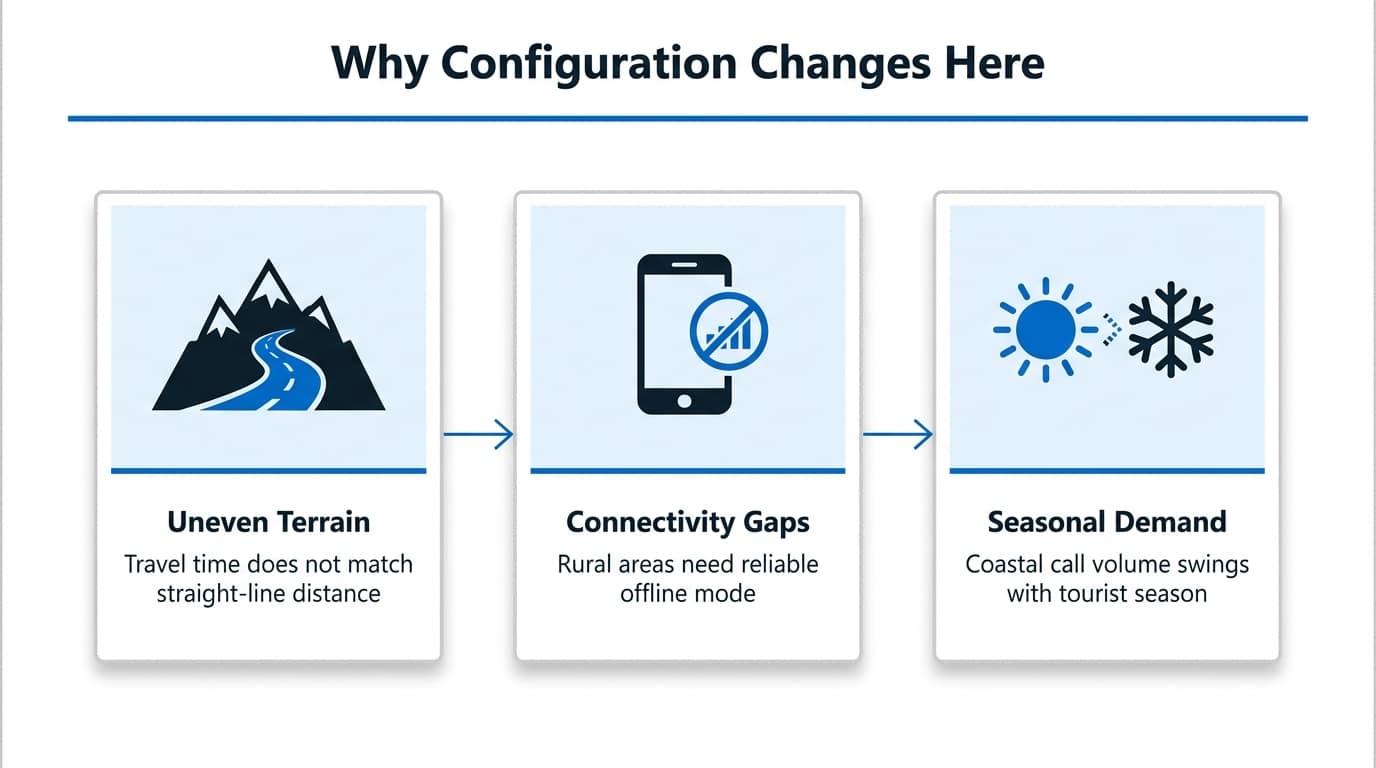
Three things about the region change how a Field Service deployment should be configured, and all three get missed by a generic implementation.
Geography isn’t uniform. A technician based in Málaga might serve the dense coastal strip one day and a mountain village in the Axarquía or the Serranía de Ronda the next. Straight-line distance means very little here; drive time between two points on the coast can be a fraction of the same distance inland. Territories and scheduling that assume flat, uniform travel time will misallocate jobs and quietly inflate technicians’ actual working days.
Mobile connectivity isn’t guaranteed. Rural stretches of inland Andalucía and mountain routes have genuine mobile signal gaps. A technician who can’t load a work order or capture a signature on-site because they’ve assumed connectivity is a support ticket waiting to happen, not an edge case.
Demand isn’t flat across the year. Coastal businesses tied to tourism, hospitality maintenance, HVAC servicing, pool and property upkeep, see real seasonal swings in call volume. A resourcing model sized for a quiet February will buckle in July.
Sectors We See Using Field Service Across the Region
Hospitality and property maintenance on the Costa del Sol
HVAC, pool, and general maintenance providers serving hotels and holiday properties along the coast deal with a dense concentration of sites and a summer call-volume spike. Field Service earns its keep here through territory design that reflects real coastal density rather than an even geographic split, and through preventive maintenance agreements that catch equipment failures before they happen during peak occupancy.
Logistics and equipment servicing around the Port of Málaga
Businesses maintaining handling equipment, refrigeration units, and vehicles around Málaga’s port and surrounding industrial estates need fast turnaround on urgent call-outs without derailing planned maintenance schedules. This is where resource scheduling optimization and clear escalation rules for emergency work matter more than in most other sectors.
Agrifood equipment maintenance toward Almería
Eastern Andalucía’s greenhouse and agrifood belt runs on climate control, irrigation, and cold-chain equipment that cannot tolerate long downtime. For businesses servicing this equipment, Field Service’s agreements and preventive maintenance scheduling reduce the number of emergency call-outs that arrive as a genuine crop or stock risk rather than a routine fix.
Multi-site professional and technical services inland
IT, telecoms, and technical equipment providers with clients scattered across smaller inland towns face the connectivity and travel-time challenges described above most acutely. A well-configured mobile app with reliable offline support is often the difference between technicians logging work accurately and a dispatcher chasing paperwork days later.
Configuring Territories for Real Andalusian Geography
The single highest-leverage configuration decision for a regional deployment is how territories and resource pools are drawn. Rather than splitting Andalucía into administrative provinces or even coverage circles, model territories around actual drive-time clusters: coastal technicians grouped separately from inland ones even when they technically share a province boundary, and travel-time-aware scheduling switched on so the system accounts for real road routes rather than straight-line distance.
Resource scheduling optimization, covered in our Field Service guide, becomes considerably more valuable once territories reflect real terrain: the algorithm can only route intelligently if the travel-time data it’s working from is accurate. For the mobile side, enable offline data sync and test it deliberately in the lower-connectivity areas your technicians actually cover, not just in the office.
From Completed Job to Compliant Invoice
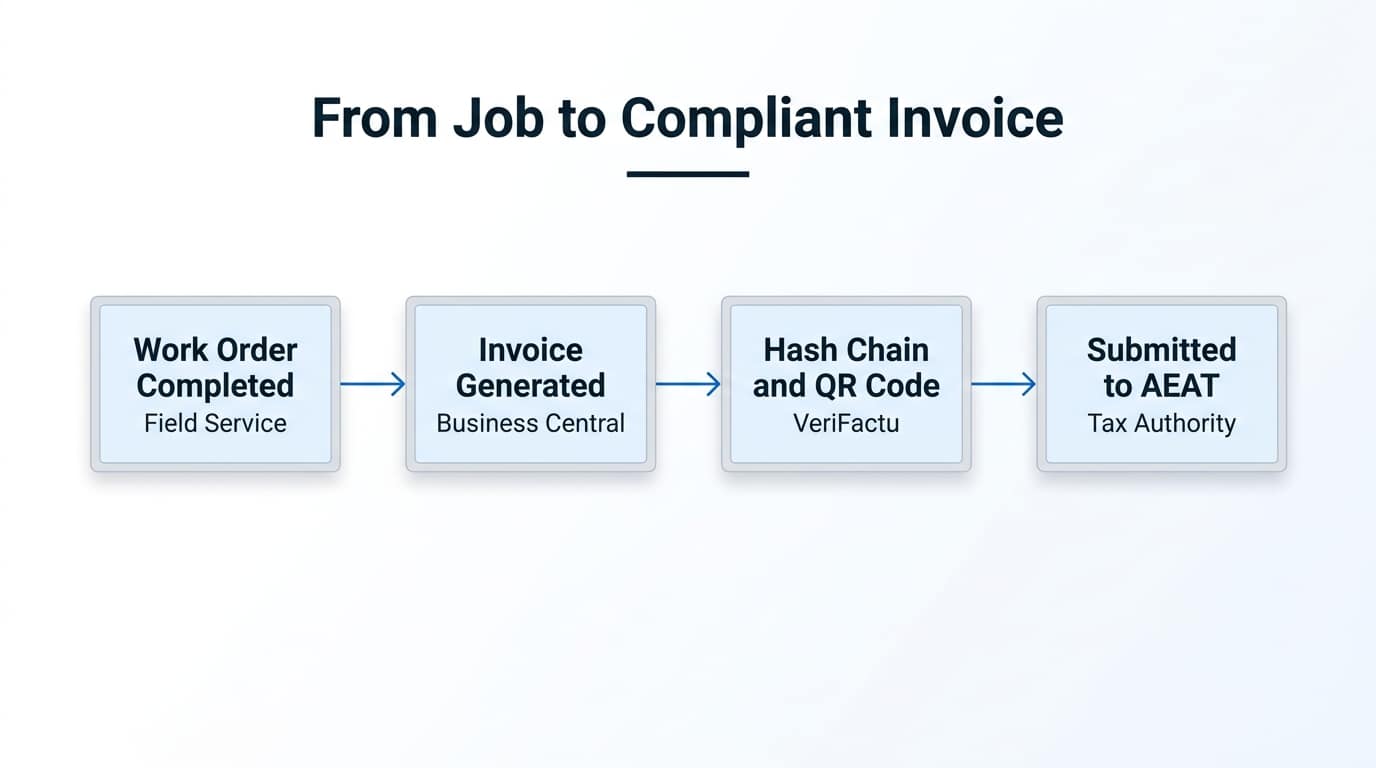
A completed field service job in Spain doesn’t end when the technician closes the work order. If your back office runs on Business Central, that job typically becomes an invoice, and that invoice is subject to VeriFactu’s hash-chained record and QR code requirements, with compliance deadlines now set for January and July 2027 following the postponement covered in our VeriFactu compliance guide. Getting the connection between Field Service job completion and Business Central invoicing right at configuration time avoids a gap where completed work sits unbilled or gets invoiced through a workaround that falls outside your compliant invoicing flow.
Frequently Asked Questions
Do we need separate territories for each Andalusian province?
Not necessarily by province. Territories work better when they follow real technician travel patterns, coastal density, inland spread, than administrative boundaries. Two neighbouring provinces with good road links between their coastal towns might reasonably share a territory, while a single large inland province could need splitting.
What happens when a technician loses signal mid-job in a rural area?
With offline mode configured correctly, the technician keeps working; work order updates, parts used, and time logged all queue locally on the device and sync automatically once signal returns. The prerequisite is testing this deliberately during setup in the actual low-connectivity areas your team covers, not assuming it will work because it works in a demo.
How do we handle the summer demand spike without overstaffing in winter?
Resource scheduling optimization helps absorb some of the swing by using existing technicians more efficiently, but a genuine seasonal spike in coastal, tourism-linked sectors usually still needs seasonal or contract technician capacity. Configure those temporary resources with the same skills and territory data as permanent staff so the schedule board treats them identically during peak months.
Does Field Service handle multilingual technician documentation?
Yes. Work order instructions, forms, and the mobile app interface can be configured in Spanish alongside English, which matters for teams where technicians and dispatchers work primarily in Spanish even if head-office reporting is in English.
Getting Started
If you’re running field teams anywhere in Andalucía, hospitality maintenance on the coast, logistics around Málaga, agrifood equipment further east, or multi-site technical services inland, the configuration work that matters most happens before go-live: mapping real territories, testing offline mode where signal is genuinely weak, and connecting job completion cleanly to compliant invoicing. AlishBit implements Dynamics 365 Field Service for businesses across Andalucía and Spain, and we’re happy to talk through what that setup looks like for your team.
Running Field Teams Across Andalucía?
AlishBit implements Dynamics 365 Field Service for businesses across Spain and Europe. Book a free consultation and talk through your territories, technicians, and compliance setup.