VeriFactu is Spain’s anti-fraud invoicing regulation, and if your business issues invoices from software in Spain, it almost certainly affects you. The good news: Business Central’s Spanish localization includes built-in VERI*FACTU support, so compliance is largely a matter of updating, configuring, and testing rather than buying new software.
The obligation is real, but the clock has been reset once already. Royal Decree-Law 15/2025, published in the BOE on 3 December 2025, postponed the compliance deadlines to 2027. This guide explains what VeriFactu actually requires, who must comply and when, how it relates to the SII, and the concrete steps to get your Business Central environment ready.

What Is VeriFactu?
VeriFactu comes from Spain’s anti-fraud law (Ley 11/2021) and was given technical shape by Royal Decree 1007/2023, the regulation governing invoicing software, known as the Reglamento de Requisitos de los Sistemas Informáticos de Facturación. You can read the decree itself on the official BOE website. Its goal is simple: make it technically impossible to issue an invoice and later delete or alter it without leaving a trace.
In practice, the regulation requires invoicing software (a “SIF” in the jargon) to do several things:
- Generate a billing record for every invoice, chained to the previous record with a cryptographic hash so gaps and alterations are detectable
- Keep an event log of relevant actions in the system
- Print a QR code on every invoice so recipients can verify it with the tax agency
- Either send each billing record to the AEAT in real time (the VERI*FACTU mode, which lets you label invoices “factura verificable”) or sign and store the records locally, ready for inspection
Notice what this is not: VeriFactu doesn’t force you to send electronic invoices to your customers. It regulates how your software creates and protects invoice records. Mandatory B2B e-invoicing in Spain is a separate obligation under the Crea y Crece law, still awaiting its final technical regulation as of mid-2026.
Who Must Comply, and by When?
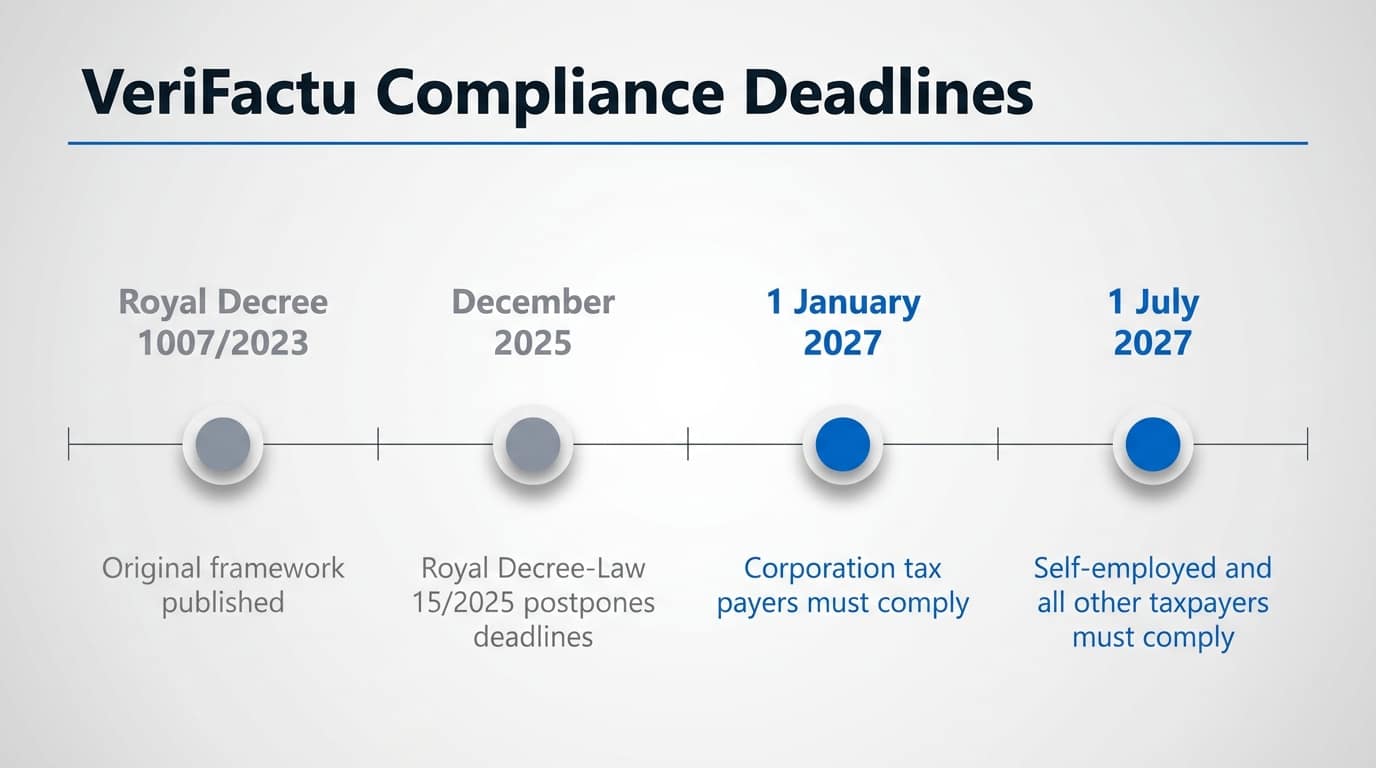
VeriFactu applies to businesses and self-employed professionals in Spain’s common tax territory who use software to issue invoices and are not already covered by the SII. The deadlines have moved more than once: the original schedule required compliance from 2026, and Royal Decree-Law 15/2025, published in the BOE on 3 December 2025, pushed that back again. The current schedule is:
- 1 January 2027: corporation tax payers (most SL and SA companies) must use compliant invoicing software
- 1 July 2027: everyone else in scope, including the self-employed (autónomos) and entities under income tax rules
- Software vendors had to offer compliant products from 29 July 2025
Treat these dates as subject to change and confirm them on the AEAT’s official VeriFactu page before making decisions; the calendar has moved before, and transitional criteria have been clarified several times.
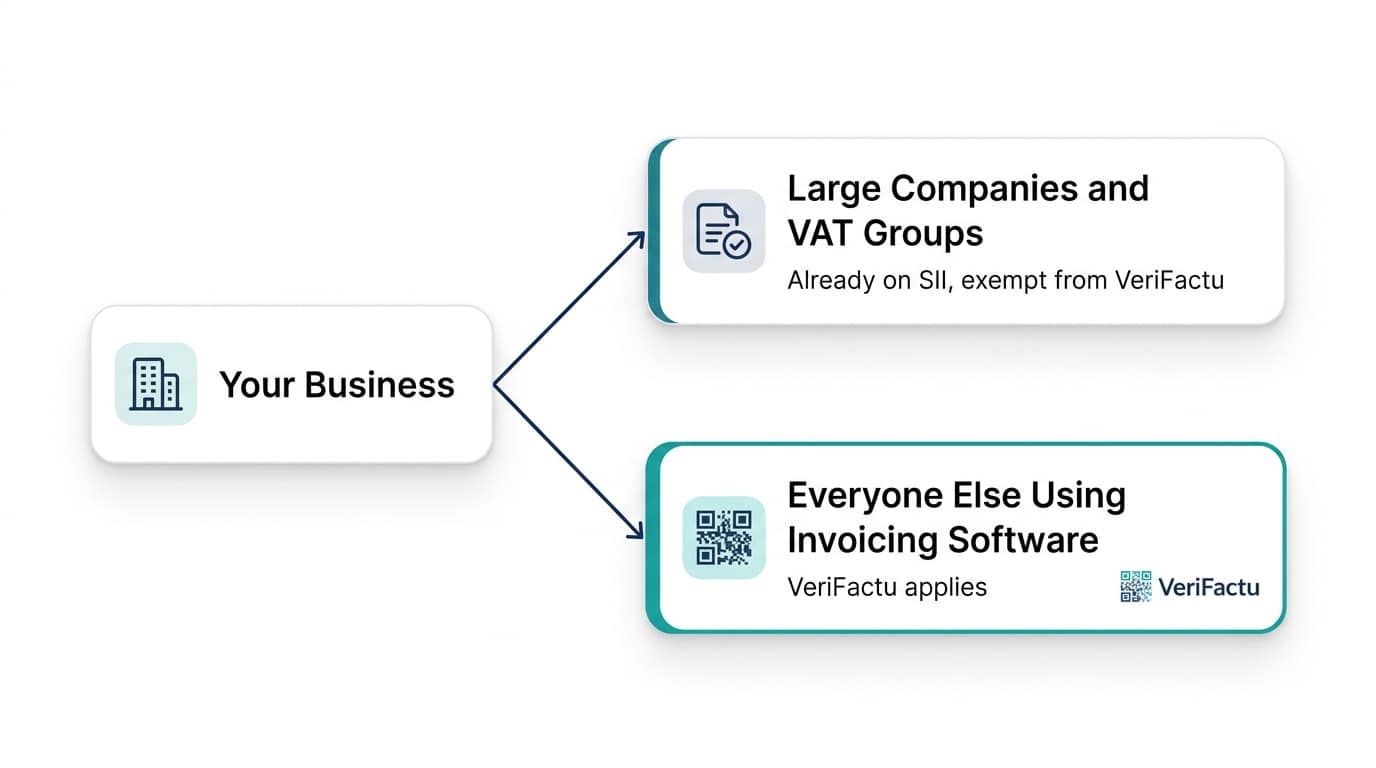
Two important groups sit outside VeriFactu. Companies already reporting through the SII are exempt, since the tax agency already receives their invoice data. And businesses taxed in the Basque Country or Navarra follow their own systems, TicketBAI and Batuz, which have similar goals but different rules.
How Does VeriFactu Relate to the SII?
The SII (Suministro Inmediato de Información) has been running since 2017. It obliges large companies with turnover above 6 million euros, VAT groups, and businesses registered for monthly VAT refunds (REDEME) to submit their VAT ledgers to the AEAT electronically, generally within four working days of issuing or recording an invoice.
Think of it this way: SII reports your VAT books after the fact, while VeriFactu controls the invoicing software at the moment an invoice is created. Because SII filers already give the AEAT near-real-time visibility, they’re excused from VeriFactu. For a growing Spanish SME, this creates a fork in the road: you’ll comply through one system or the other, and which one depends on your size and VAT registrations. If your reporting obligations are piling up generally, our post on automating compliance and reporting with Power Automate shows how Spanish businesses take the manual work out of it.
How Does Business Central Keep You Compliant?
The Spanish localization of Business Central has long included SII submission as a standard feature: posted sales and purchase documents flow to the AEAT with status tracking and error handling inside the application. Microsoft documents the full Spanish feature set in its Spain local functionality documentation.
For VeriFactu, Microsoft added VERI*FACTU support to the Spanish version across recent release waves. Once enabled and configured, Business Central generates the chained, hash-linked billing records the decree requires, prints the verification QR code on sales invoices, and submits billing records to the AEAT when you operate in VERI*FACTU mode. Because Business Central online updates continuously, regulatory adjustments arrive through Microsoft’s standard release process rather than through a paid upgrade project.
That last point deserves emphasis. Businesses still running older on-premises ERP versions, including old Dynamics NAV releases, won’t receive VeriFactu updates. If that’s you, the regulation is effectively a deadline for modernizing your ERP, and it’s one reason Spanish SMEs have been accelerating moves to Business Central online, something we see regularly in Dynamics 365 implementations across Spain.
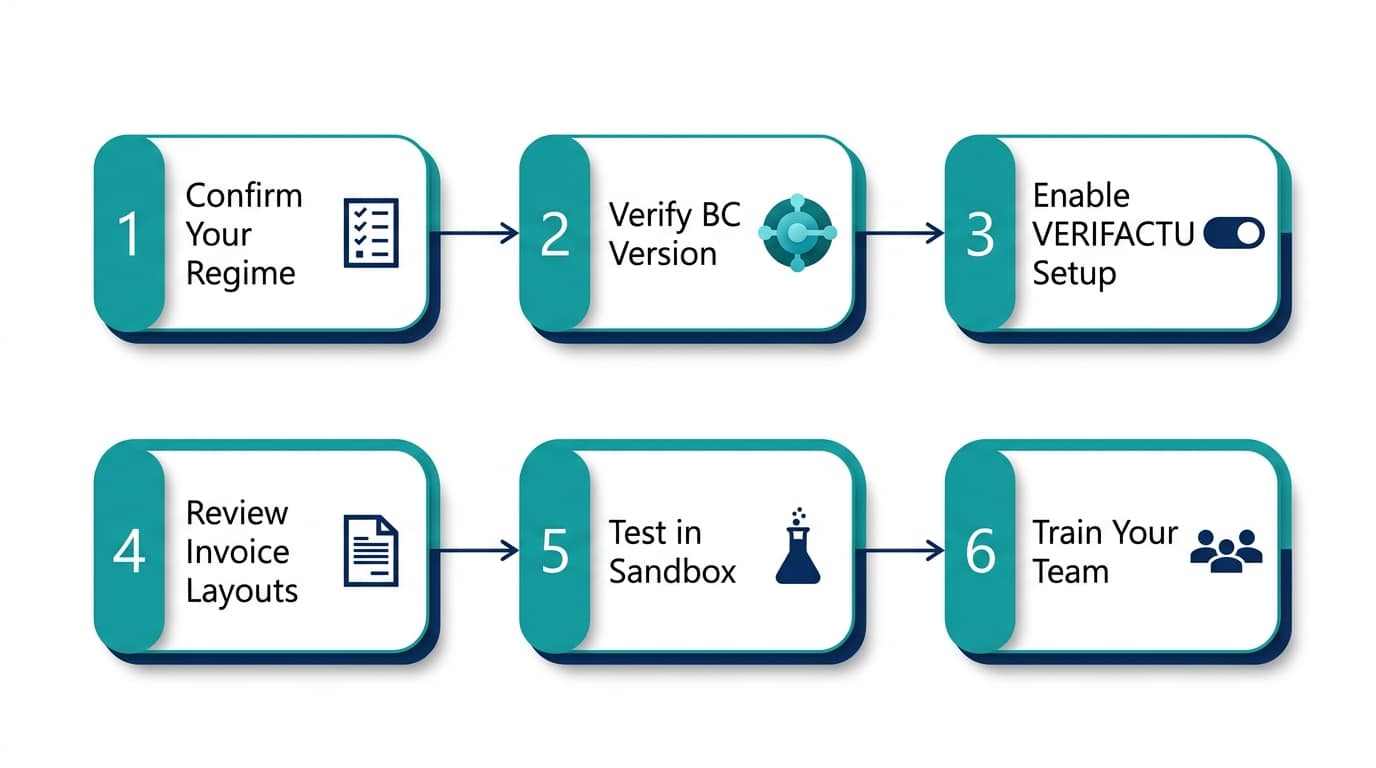
Six Steps to Prepare Your Business Central Environment
- Confirm which regime applies to you. Check whether you fall under SII (already exempt from VeriFactu), TicketBAI or Batuz (Basque Country and Navarra), or VeriFactu. Your asesor fiscal can confirm in one conversation.
- Verify your Business Central version. Online tenants on current updates have the Spanish localization features available. On-premises customers should plan an upgrade to a supported version, since compliance features target current releases.
- Enable and configure the VERI*FACTU functionality. This includes deciding between VERI*FACTU mode (real-time submission) and the non-remittance mode, and setting up the digital certificate that authenticates your company with the AEAT.
- Review your invoice layouts. The QR code and, in VERI*FACTU mode, the “factura verificable” wording must appear on printed and PDF invoices, so custom report layouts may need adjusting.
- Test in a sandbox first. Issue test invoices, credit memos, and corrections in a sandbox environment and verify the records chain correctly before touching production.
- Train the people who invoice. Staff should understand that invoices can no longer be quietly deleted or edited after posting; corrections must flow through proper credit memos, which is good discipline anyway.
If your billing process involves approval steps or notifications around invoicing, this is also a sensible moment to tidy them up; our guide to automating workflows with Power Automate covers the best practices we apply in these projects.
Frequently Asked Questions
Is VeriFactu the same as mandatory B2B e-invoicing in Spain?
No. VeriFactu regulates how invoicing software creates and protects invoice records. The mandatory B2B electronic invoice comes from the Crea y Crece law and will oblige businesses to exchange structured e-invoices with each other. Its technical regulation was still pending final approval as of mid-2026, so VeriFactu is the obligation to act on first.
What are the penalties for non-compliance?
Ley 11/2021 introduced specific infractions: software producers selling non-compliant systems face fines of up to €150,000 per year and system type, and businesses merely possessing non-certified invoicing software risk fines of up to €50,000 per year. Beyond fines, non-compliant records weaken your position in any tax inspection, which is often the costlier consequence.
Do I have to use the real-time VERI*FACTU mode?
No, the decree allows two modes. You can send every billing record to the AEAT as it’s created, or keep signed, chained records locally and produce them on demand. Many advisors favor the real-time mode because it simplifies evidence requirements and lets invoices carry the “verifiable invoice” label, but it’s a choice to make with your tax advisor.
I’m on the SII already. Can I ignore VeriFactu?
Largely yes: SII filers are exempt because the AEAT already receives their invoice data within days. Keep an eye on your own status, though. If your turnover drops below the SII threshold or you leave REDEME, you could fall into VeriFactu scope, so the exemption is worth rechecking whenever your VAT situation changes.
Getting Compliant Without the Headache
VeriFactu rewards businesses that prepare early and calmly: confirm your scope, update your software, configure, test, and train. For companies on Business Central, most of the heavy lifting is already done by the Spanish localization. AlishBit is a Microsoft partner based in Málaga, and we help Spanish businesses configure Business Central for VeriFactu and SII, upgrade from older systems, and keep compliance features current; if you’d like a review of where your environment stands, you can schedule a meeting with our team.
Planning Your ERP Project?
AlishBit implements Dynamics 365 Business Central for SMEs across Spain and Europe. Book a free consultation and get realistic advice on scope, cost and timeline.