Our case studies showcase real implementation results from AlishBit projects. The best evidence of what a Dynamics 365 implementation can achieve is not a feature list. It is what actually happened for a business that went through the process. Below are three case studies from recent Alishbit projects. Client names and identifying details have been anonymised in line with standard professional practice to protect client confidentiality.
Case Study 1: Consolidating Operations for a Logistics Company in Andalusia
Client
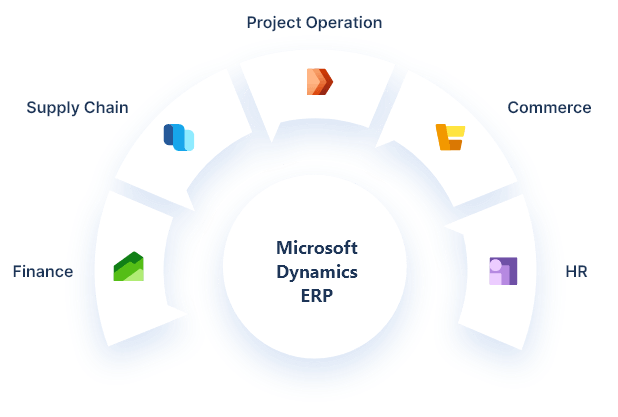
A mid-sized logistics and freight forwarding company based in Malaga, with 45 employees across two offices in Andalusia. The business manages domestic and international shipments and serves clients in manufacturing, retail, and food distribution.
The Challenge
The company was operating across three separate systems: a legacy freight management application, a standalone CRM built on an outdated platform, and a spreadsheet-based finance tracking process. None of these systems communicated with each other, which meant that data had to be re-entered multiple times and reporting required manual collation from multiple sources.
The commercial team had no visibility of operational status for client shipments, so account managers were fielding status calls they could not answer without phoning a different department. Finance was spending approximately 12 hours per week producing management reports that should have been available in real time. Leadership had no single view of business performance.
What Alishbit Implemented
Alishbit designed and delivered a unified Dynamics 365 environment built around three core components. Dynamics 365 Sales was configured to manage the full commercial pipeline, from lead capture through to account management for existing clients. Custom entities were created to link client accounts directly to active shipment records, giving account managers real-time visibility of job status without leaving the CRM.
Dynamics 365 Business Central was implemented to replace the spreadsheet-based finance process, with direct integration to the sales module so that invoicing, revenue recognition, and cash flow reporting were automatically updated as deals progressed. Power Automate workflows were built to handle routine notifications: alerting account managers when shipment milestones were reached and triggering invoice generation when jobs were marked complete.
The legacy freight management system was retained but connected to Dynamics via a Power Automate integration that synchronised shipment status updates bidirectionally, eliminating the need for manual re-entry.
The Outcome
- Manual reporting time reduced by 65%, saving the finance team approximately 8 hours per week
- Three previously separate systems consolidated into a single Microsoft 365 environment
- Account managers gained real-time shipment visibility, reducing inbound status enquiry calls by an estimated 40%
- Management dashboards deployed in Power BI, giving leadership a live view of revenue pipeline, operational capacity, and client activity
- Full GDPR compliance review completed as part of the project, with data retention policies and consent tracking configured within Dynamics
- This example demonstrates measurable outcomes achievable through structured implementation
Case Study 2: Scaling Marketing and Customer Engagement for a Professional Services Firm in Spain
Client
A professional services company operating across Spain with approximately 30 staff, providing advisory and outsourced services to SMEs in the legal, accountancy, and HR sectors. The firm had grown significantly through referrals but was looking to build a more structured approach to marketing and client retention.
The Challenge
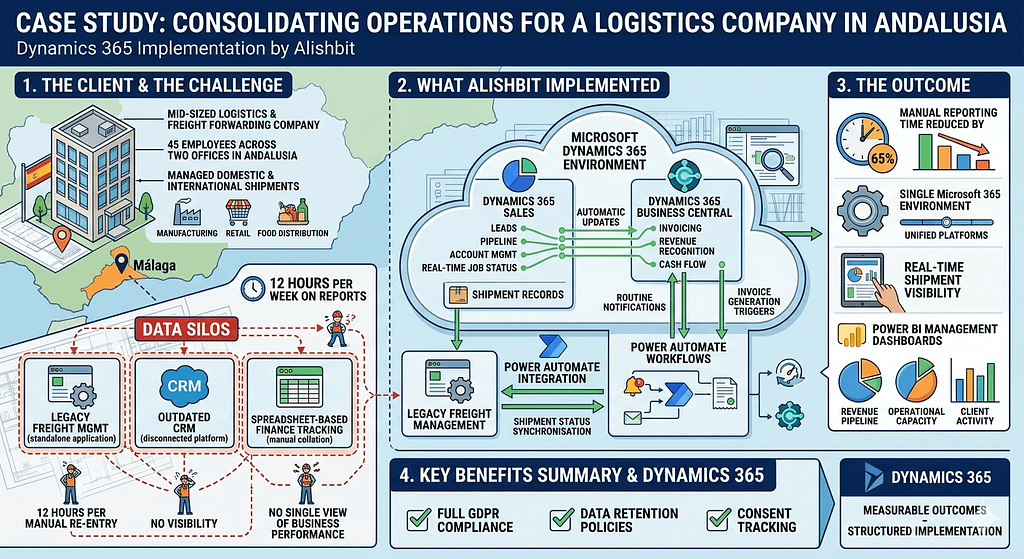
The firm had no CRM in place. Client relationships existed primarily in individual email inboxes and the personal knowledge of fee earners, which created significant risk around staff turnover and made cross-selling across service lines almost impossible. Marketing activity was ad hoc: occasional newsletters sent from a personal Gmail account with no segmentation, no tracking, and no follow-up process.
The firm wanted to formalise client data management, launch a structured marketing programme targeting existing clients and warm prospects, and create a consistent onboarding experience for new clients. They also needed to ensure their approach to data processing complied with GDPR, as their client base includes companies subject to significant regulatory scrutiny.
What Alishbit Implemented
Alishbit implemented Dynamics 365 Sales as the central client relationship platform, migrating contact and account data from a combination of Outlook contacts and spreadsheets. A structured account hierarchy was established to reflect the firm’s service line structure, with clear ownership rules and activity tracking across the team.
Dynamics 365 Customer Insights: Journeys was configured to power the firm’s marketing programme. Audience segments were built based on service line, client lifecycle stage, and engagement history. Automated journey sequences were created for new client onboarding, quarterly check-in communications, and a structured nurture track for warm prospects who had enquired but not yet converted.
A Power Apps portal was built to provide a lightweight client-facing interface for document sharing and communication logging, reducing the volume of email traffic for routine client interactions. GDPR consent management was implemented within Customer Insights, with a double opt-in process for marketing communications and a documented data retention policy. The implementation was delivered in structured phases.
The Outcome
- Client data consolidated from 4 separate sources into a single, clean Dynamics 365 environment
- First structured marketing campaign launched within 6 weeks of go-live, generating 14 qualified enquiries in the first 90 days
- New client onboarding time reduced by 50% through automated workflows and the Power Apps portal
- Cross-sell rate increased as account managers gained visibility of which service lines each client was and was not using
- Full GDPR compliance documentation produced, including a data processing register and consent management audit trail
- This case study reflects proven results from a real business in Spain
Case Study 3: From Word Quotes to a Connected CRM for a Power Infrastructure Manufacturer
Client
A US-based manufacturer of custom-built power infrastructure equipment: transformers, switchgear, and circuit breakers built to order for data center, utility, and industrial EPC customers. Products are engineered to spec rather than sold off the shelf, and lead times run from weeks to months depending on the product line.
The Challenge
Before the implementation, every quote was built manually in Microsoft Word, with the full technical specification for each transformer retyped or copy-pasted in for every new request. Alongside this, the sales team kept a separate set of Excel sheets to track what had actually been sold, to which client, and at what price. Because neither the quotes nor the sales history lived in a shared system, there was no reliable way to look up what a given client had previously ordered or paid, and every new quote started close to from scratch.
What Alishbit Implemented
Alishbit implemented Dynamics 365 Sales as the client’s central CRM, built around a configurable product catalog for their transformer lines. Instead of a rep retyping specifications into a document, each transformer is modeled as a configurable product, so a quote is built by selecting the applicable configuration rather than writing the specification by hand.

Dynamics 365 Sales was connected to the client’s existing Business Central environment using Microsoft’s native Dataverse integration, which keeps standard entities, customers, sales orders, and invoices, in sync automatically. The client had already extended Business Central with custom fields and additional tables to capture information specific to their production process, on orders and invoices in particular, so Alishbit built supporting Power Automate flows that call the corresponding custom Business Central APIs and bring those extended fields into CRM as well.
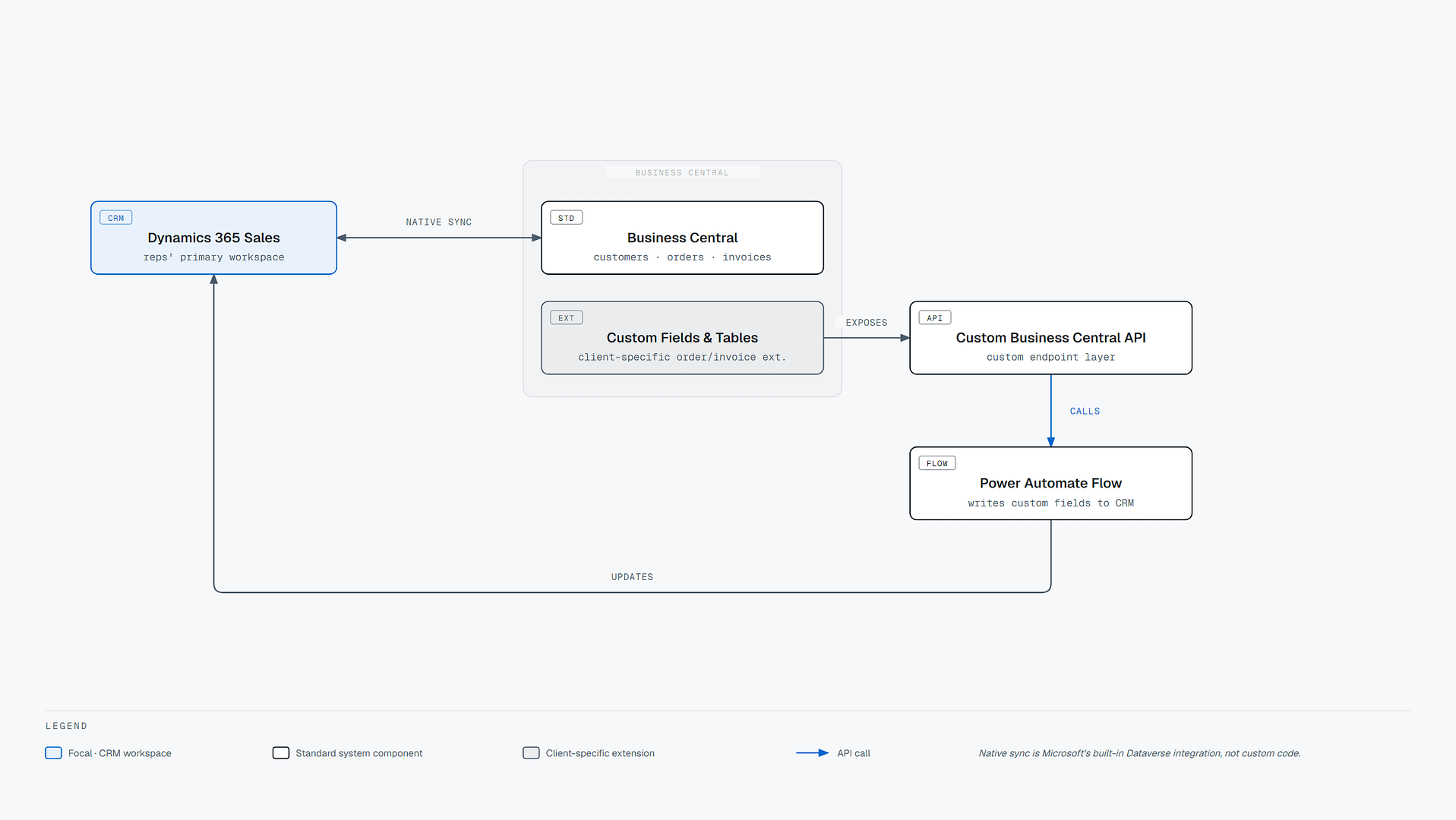
The full implementation, from initial scoping through go-live, was delivered in 60 days.

The Outcome
- Every quote and completed sale is now tied to a CRM record, replacing quotes that were previously built from scratch in Word
- The separate Excel sheets the sales team maintained to track what had been sold, to which client, and at what price were retired once that information lived directly in CRM and Business Central
- Transformers are now quoted against a configurable product catalog, replacing manual retyping of specifications for every quote
- Standard Business Central data, customers, orders, and invoices, stays in sync with CRM through Microsoft’s native integration, extended with Power Automate flows to cover the client’s custom Business Central fields and tables
- The implementation was delivered in 60 days, from initial scoping to go-live
Dynamics 365 Case Studies: Interested in What a Similar Approach Could Achieve for Your Business?
Every Alishbit project starts with a free consultation to understand your current situation and explore what Dynamics 365 could realistically deliver for your team. We work with businesses across Malaga, Seville, Granada, and the wider Spain region, as well as clients further afield.
Whether you’re looking for inspiration or ready to begin your own project, these case studies show what’s achievable with the right partner. Learn more about Microsoft Dynamics 365.